
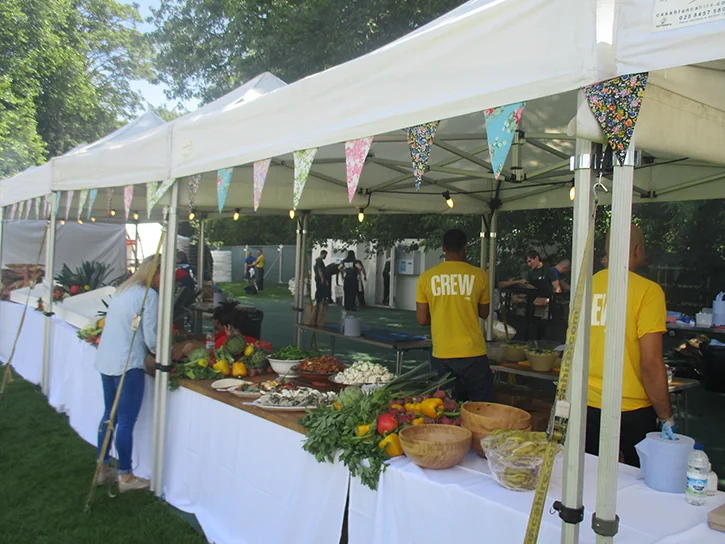
Organising catering for an outdoor event can be considerably more complicated than catering inside a permanent venue. Whether you are planning a food festival, community celebration, music festival, corporate event, summer fair or another large outdoor gathering, almost everything that would normally be provided by a venue needs to be considered separately.
Caterers may need temporary preparation areas, refrigeration, cooking equipment, serving stations, tables, storage, washing facilities and waste management. Event organisers also need to think about electricity, water, access, weather protection and how equipment will be delivered and collected.
The larger the event becomes, the more important this planning is. A missing refrigerator or insufficient preparation space can quickly become a serious problem when hundreds or thousands of visitors are expected.
This outdoor event catering checklist covers the main areas worth considering when planning catering for a festival or large outdoor event.
1. Start With Expected Visitor Numbers
Before deciding what catering equipment you need, establish a realistic estimate of how many people will attend.
A small community event attracting a few hundred visitors has very different requirements from a festival expecting several thousand people throughout the day.
Visitor numbers influence almost every other catering decision, including the number of food vendors required, refrigeration capacity, preparation space, serving equipment, waste facilities and the amount of furniture needed.
It is also worth considering how visitors will arrive throughout the event. A festival lasting eight hours may have 5,000 visitors in total, but they are unlikely to arrive or eat at exactly the same time.
Identify likely peak periods.
For example, lunchtime can create a sudden increase in demand across food stalls. If an evening performance is scheduled, another rush may occur shortly before the headline act begins.
Understanding these patterns helps caterers and organisers determine the capacity they need rather than simply planning around the total attendance figure.
2. Decide How Catering Will Be Provided
There are several ways to organise catering at an outdoor event.
Some events employ one catering company to manage most food and drink operations. Others invite independent street-food traders, mobile catering businesses and bars to operate their own units.
Large festivals often use a mixture of both.
You might have independent food traders serving visitors while separate catering facilities are provided for VIP areas, performers, staff and backstage teams.
Establishing this structure early makes it much easier to determine which equipment needs to be hired centrally and what individual caterers will provide themselves.
Ask every catering supplier what they are bringing and what they expect the organiser to provide.
Assuming that somebody else is supplying a refrigerator, table, power connection or sink is an easy way to discover gaps when everyone arrives on site.
3. Create a Catering Equipment List
Once you understand who will be serving food and approximately how many visitors you expect, start creating a detailed equipment list.
Requirements vary significantly between events, but common catering hire equipment can include:
- Preparation tables and work surfaces
- Refrigerators and freezers
- Heated cupboards and hot holding equipment
- Ovens and cooking equipment
- Serving tables and counters
- Sinks and washing equipment
- Shelving and storage
- Crockery
- Cutlery
- Glassware
- Serving utensils
- Drinks equipment
- Bar equipment
- Waste bins
- Tables and chairs
Avoid treating this as one large list for the entire event.
Breaking requirements down by area is usually much easier.
For example, create separate equipment lists for the main kitchen, public food service, VIP catering, bars, staff catering and backstage areas.
This makes it easier to identify where each piece of equipment needs to go when deliveries arrive.
4. Plan Your Food Preparation Areas
Outdoor events often need temporary food preparation areas.
These should be planned with workflow in mind rather than simply finding an unused section of the site and placing equipment there.
Think about how ingredients will move through the catering operation.
Food may arrive at a delivery point, move into dry or refrigerated storage, continue into preparation areas and finally reach cooking and serving stations.
A logical layout reduces unnecessary movement and helps catering teams work efficiently during busy periods.
Preparation areas should also have enough work surfaces for the number of staff using them.
Trying to operate a large catering service from a couple of small tables can quickly cause delays.
Where possible, separate preparation, cooking, washing and storage areas rather than trying to perform every task in the same space.
5. Make Sure You Have Enough Refrigeration
Refrigeration is one of the most important considerations when catering outdoors.
Unlike a restaurant or hotel kitchen, an outdoor site does not automatically provide cold storage.
Depending on the event, caterers may require upright refrigerators, under-counter refrigeration, freezers or larger refrigerated storage facilities.
Capacity should be calculated before the event rather than relying on estimates once deliveries start arriving.
Consider not only ingredients but also drinks, garnishes and other products that need to remain chilled.
Outdoor temperatures also matter. Refrigeration requirements during a summer festival can be considerably greater than those for an indoor winter event.
Equipment positioning is important too. Refrigerators should be accessible to catering teams without obstructing preparation or service areas.
6. Provide Suitable Covered Areas
British weather makes shelter an important part of almost any outdoor event plan.
Even when the forecast looks promising, catering operations need contingency arrangements for rain, wind and strong sunshine.
Food preparation areas, bars, serving points and storage areas may all require some form of cover.
For larger sites, organisers frequently incorporate marquees for festivals and outdoor events into the overall infrastructure plan, providing protected spaces for catering operations, hospitality areas, bars, staff facilities and other event functions.
The size and style of structure required depends on how the space will be used.
A catering preparation area has different requirements from a public dining marquee, for example. Back-of-house structures are generally focused on practical access and working space, while hospitality structures may also need flooring, furniture, lighting and interior presentation.
Plan these spaces alongside your catering layout rather than treating them as separate elements.
You need to know where equipment will sit, how caterers will enter and exit, and how supplies will reach the area.
7. Think Carefully About Power
Temporary power is another major consideration at outdoor events.
Catering equipment can consume significant amounts of electricity, particularly when refrigeration, cooking and hot-holding equipment are operating simultaneously.
Create a list of every electrical appliance being used and confirm its power requirements.
Do the same for independent caterers.
Simply asking whether somebody “needs electricity” is not enough. You need to know what equipment they intend to connect and its electrical requirements.
Once you have this information, your electrical or temporary power supplier can plan suitable distribution around the site.
Try to avoid long cable runs through areas with heavy pedestrian traffic.
Power distribution should be incorporated into the overall site plan alongside catering locations, bars, stages, lighting and other infrastructure.
Backup arrangements may also be appropriate for essential equipment, particularly refrigeration.
8. Don’t Forget Water
Temporary catering operations need reliable access to water.
The exact requirements depend on the event and catering setup, but water may be needed for food preparation, hand washing, equipment cleaning and general hygiene.
When planning the site, determine where water will come from and how it will reach each catering area.
If temporary water infrastructure is required, it should be planned before traders and equipment arrive.
Long distances between catering areas and water points can create unnecessary work and make maintaining an efficient operation much more difficult.
Wastewater must also be considered. Caterers should know how and where wastewater can be disposed of appropriately rather than improvising during the event.
9. Plan Hand-Washing and Cleaning Facilities
Good hygiene facilities are essential for outdoor catering.
Hand-washing stations should be conveniently positioned for catering staff and should not require workers to leave their operating area unnecessarily.
Cleaning facilities should also be appropriate for the scale of the catering operation.
For events using reusable crockery, glasses or serving equipment, the volume of washing can become substantial.
Consider how dirty items will be collected, washed and returned to service without interfering with food preparation.
If several catering operations share facilities, make sure those facilities have sufficient capacity during peak periods.
10. Organise Storage Before the Event
Storage tends to receive less attention than cooking and serving equipment, but inadequate storage can create significant problems.
Caterers may need somewhere to keep dry ingredients, packaging, spare utensils, cleaning products and replacement stock.
Bars may require substantial storage for drinks, glasses and consumables.
Keep storage areas organised and, where appropriate, separated from public areas.
Shelving can make temporary catering spaces considerably more efficient because supplies can be stored vertically rather than occupying valuable preparation surfaces.
It is also worth planning how stock will be replenished during the event.
If replacement supplies are stored on the opposite side of a large festival site, catering teams may lose considerable time moving between locations.
11. Plan Your Bars Separately
Bars should normally have their own equipment and infrastructure plan.
Requirements can include bar counters, refrigeration, glassware, ice storage, sinks, shelving, waste bins and point-of-sale equipment.
Location is particularly important.
A popular bar placed in a narrow area can create queues that interfere with pedestrian movement or access to nearby food vendors.
For larger events, several smaller bars positioned around the site may work better than one central bar.
Also consider how stock will reach each bar.
Delivering crates through a dense crowd is far more difficult than restocking through a dedicated back-of-house route.
12. Consider Seating and Dining Areas
Not every outdoor event needs formal dining furniture, but visitors usually appreciate somewhere to sit while eating.
Depending on the style of event, this might include traditional tables and chairs, picnic benches, poseur tables or covered hospitality seating.
Estimate how long visitors are likely to occupy tables.
At a food festival, people may eat and move on relatively quickly. At a corporate hospitality event, guests may remain seated for considerably longer.
You do not necessarily need a seat for every attendee, particularly at festivals where people move around throughout the day.
Instead, consider how catering fits into the overall visitor experience and provide appropriate seating in areas where people are likely to eat.
13. Keep Public and Back-of-House Routes Separate
Site logistics can make a huge difference to how smoothly catering operates.
Where possible, delivery vehicles, catering staff and stock should be able to move around without passing through crowded public areas.
A back-of-house route allows supplies to reach kitchens, bars and catering units safely and efficiently.
It also makes waste collection easier.
This becomes particularly important at large events where deliveries or restocking may continue after the gates have opened.
Mark these routes clearly on the site plan and make sure suppliers understand where they should enter before arriving.
14. Schedule Equipment Deliveries
Avoid having every supplier arrive at exactly the same time.
Marquees and temporary structures may need to be installed first, followed by power and other infrastructure before catering equipment can be positioned.
The correct order depends on your event, but creating an installation schedule helps prevent contractors from getting in each other’s way.
Catering equipment should ideally arrive when the areas receiving it are accessible and ready.
Give suppliers clear information before delivery, including the site entrance, contact person, unloading location and any vehicle restrictions.
For larger events, somebody should be responsible for coordinating deliveries on site.
15. Prepare for Bad Weather
Weather planning should go beyond providing shelter from rain.
Strong winds, extreme heat and wet ground can all affect catering operations.
Rain may change pedestrian routes and cause visitors to congregate under covered areas. Hot weather can increase demand for cold drinks and place additional pressure on refrigeration.
Ground conditions should also be considered.
Heavy equipment can be difficult to move across wet grass, particularly after several days of rain.
Temporary flooring or trackways may be required in high-traffic or operational areas.
Check forecasts in the days before the event, but do not rely entirely on them. Your basic site plan should still work if conditions are less favourable than expected.
16. Have a Waste Management Plan
Food and drink operations can generate large quantities of waste.
Without a clear collection system, bins around catering areas can fill surprisingly quickly.
Determine what types of waste will be produced and how they will be collected, separated and removed.
Place bins where they are easy for catering staff and visitors to use without obstructing queues or walkways.
Back-of-house catering areas should have their own waste facilities rather than relying entirely on public bins.
Collection frequency is important too. A bin that is large enough at the start of the day may be completely inadequate during the lunchtime rush.
17. Think About the Visitor Journey
Catering should be integrated into the wider event layout.
Imagine yourself arriving as a visitor.
Can you easily see where food and drinks are available? Are menus visible before you reach the front of a queue? Is there enough room to queue without blocking a main walkway?
After buying food, is there somewhere nearby to eat it?
Small layout decisions can have a significant effect on the visitor experience.
For example, placing two extremely popular food vendors immediately beside each other may create a large concentration of people in one location.
Spreading catering options around the site can improve crowd movement while encouraging visitors to explore different areas of the event.
18. Confirm Requirements With Every Supplier
In the weeks before the event, confirm arrangements with each catering supplier and contractor.
Do not assume that requirements discussed months earlier remain unchanged.
Ask catering businesses to reconfirm their equipment, power, water, access and storage requirements.
Likewise, confirm delivery and collection arrangements with catering hire suppliers.
Keep this information in one central document so the event team can access it.
For a large festival, a simple supplier schedule containing company names, contact numbers, arrival times, vehicle information and site locations can save a considerable amount of confusion during setup.
19. Create a Final Pre-Event Checklist
Several days before the event, work through the catering plan one final time.
Confirm that hired equipment has been ordered, catering areas have been allocated, power and water requirements are understood and delivery schedules have been communicated.
Check quantities carefully.
Last-minute additions are sometimes possible, but relying on them can be risky, particularly during busy summer event periods when catering equipment is already committed elsewhere.
Your final checklist should cover equipment, infrastructure, suppliers, access, staffing and contingency arrangements.
Make sure more than one member of the event team understands the plan. If the person responsible for catering logistics becomes unavailable, somebody else should be able to pick up the information and continue.
Bringing Everything Together
Successful outdoor catering is rarely about one particular piece of equipment. It depends on dozens of elements working together.
Food preparation, refrigeration, cooking equipment, water, electricity, shelter, storage, bars, furniture, waste facilities and delivery access all need to support the same operation.
The best time to identify potential problems is while looking at a site plan, not when caterers are already arriving.
Start by understanding expected attendance and deciding how catering will operate. From there, build individual equipment lists for each area and confirm what every supplier will provide.
Then consider the infrastructure surrounding that equipment.
Where will the kitchen be located? How will it receive power and water? Where will refrigerated stock be stored? How will staff move between areas? What happens if it rains? How will waste leave the site?
Answering these questions early makes the equipment itself much easier to organise.
For large festivals and outdoor events in particular, catering should be planned as part of the overall event infrastructure rather than as an isolated service.
With a clear site plan, suitable equipment and good communication between suppliers, temporary outdoor catering can operate efficiently even when thousands of visitors need to be served throughout the day.
And that means catering teams can concentrate on what matters most: providing visitors with a smooth, enjoyable food and drink experience.